

Rent Prices Are Falling Fast in America’s Most Pro-Housing Cities
From January 2024 to January 2025, average rent in Sarasota fell from $3,290 to $1,886 per month.
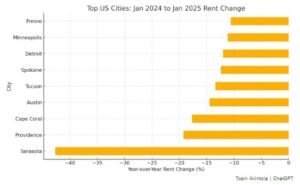
Recent Reason magazine research proves the irrefutable proposition that government housing and price regulations stop creation of new housing, serving instead to worsen shortages.
Such government interference is motivated by appeasing denizens occupying existing housing, and securing such incumbent support for staying in office. This ignores the opportunities for needy home seekers.
Specifically, Reason finds that rental prices in some of the country’s largest cities are falling—some by almost 45 percent. Further, according to data collected from investment sources, which include the top 65 metropolitan areas in the United States, cities recently passing pro-housing policies have experienced the most significant year-over-year decline in rental prices nationwide.
The data also supports recent reports from online real estate brokerages Redfin and Realtor, which detail a decline in rent prices across some of the largest metropolitan areas in the United States. Sarasota, Florida, is the city with the highest annual decline, with a 42.67 percent drop (from $3,290 to $1,886) in average rent from January 2024 to January 2025. In recent years, the City Commission has adopted a series of pro-housing policies aimed at addressing the city’s housing crisis, such as the easing of restrictions on mixed-use and higher-density developments in 2022. In 2024, the commission passed several additional measures to relax density restrictions and allocated $40 million for affordable housing projects.
On the other hand, Providence, Rhode Island, the city with the second-highest year-over-year decline, saw a 19.22 percent drop in monthly rent, from $2,513 to $2,030. Some of this decline may be attributed to policies aimed at deregulating the housing industry. In 2023, the state passed a package of housing legislation to “address the long-lagging housing production rates” in the state by streamlining permitting for land use and land development and easing restrictions around repurposing existing structures for housing. In 2024, the city of Providence streamlined its construction application process.
The data also reveals that completion of multifamily housing units is also driving rent decreases in Austin, Texas, and Cape Coral, Florida. Across the U.S., multifamily housing construction has slowed from its pre-COVID levels, partly due to regulatory hurdles, high costs, and concerns about affordability. Yet cities with the steepest rent declines, such as Austin and Cape Coral, are notably issuing building permits at or above their pre-pandemic rates. Austin, fourth in rental price drops, issued the most multifamily permits nationally (64.5 per 10,000 people). Cape Coral, third on the list, almost doubled its pre-pandemic rate with 59.6 permits per 10,000 people.
Minneapolis, which experienced an 11.14 percent annual decrease in rent, saw a 12 percent increase in housing supply between 2017 and 2022, partly fueled by its 2019 zoning reforms. In the first five years after these reforms passed, Minneapolis rents decreased by 4 percent, and Hennepin County, home to Minneapolis, has become the second-easiest county to purchase a house in compared to the seven counties adjacent to it, despite being the most populous county in the state. Minneapolis was also the first major U.S. city to end single-family-only zoning, allowing developers to mix up the types of projects they build across different neighborhoods.
While these rent decreases may be a result of a more deregulated housing industry, the author cites other factors to be considered that could be at play. Florida has been struck in recent years by Hurricanes Ian and Milton, and higher flood insurance premiums could be forcing some homeowners—especially those with second homes—to sell, creating a surplus of available housing. Consider that In March, 2025, Sarasota reached an eight-year high for its housing inventory. Still, Cape Coral and Sarasota are both expecting to see their populations increase in the coming years.
The data are clear, as the author concludes: Pro-housing policies lead to more affordable housing. Cities seeking to reduce the cost of living would be best served by adopting policies that facilitate the construction of new homes and residential buildings.
“Faction” is Killing off California Mobilehome Parks.
But California’s political system thwarts any societal change distasteful to the majority of voters, thus squelching all minority interests at the ballot box. The minority interest has no voice at all. This reality is emblematic of the principles of “faction” which dominate here. Its why we have local rent controls desipte universal condemnation of experts., builders, planners and economists. Simply, there are more tenants than landlords. Seizing the asset by controlling revenue puts the tenants in control. The source of such thinking goes back to revolutions of the early 2oth century. it is failed policy destructive of the public interest. Demonstrably so, wherever embraced.
So in progressive steps, rent control means government interdiction. Seizing the operation of property and transferring ownership and possessory interest in the form of protected subsidies to a majority of tenants or landless people aspiring to become lease holders.
The means of production are seized by (controlling revenue with forced subsidies giving tenants due process interests in the rented property), combined with barring change use or close. Property owners are forced to subsidize indefinitely. This is the equivalent of absolute authoritarian control destined to eliminate private sector operation of the asset. Thus tenants are not interested in purchasing a park; because so some have said: “we already own it.”
So California office holders placate the incumbent residents (strong voting blocs are the factions) threatened by any changes in the neighborhood. Hence Ben Allen’s retreat from a proposed bill to introduce affordable housing in the Palisades. The origins of zoning were racist, as documented by James Burling of the Pacific Legal Foundation, and this new capitulation to the white populous at the beach is the latest proof.
In sum, office holders are not leaders, they are politicians manipulating a popularity contest. They take no actions seen as detrimental to the voting majority. That majority faction maintains a tenacious grip on local politicians who are more interested in political success than executing good policy. This recipe for failure is merely indicative of a reality that municipal officials are not leaders, just manipulable empty suits navigating a vote count to sustain majoritarian control over a voting bloc of special interests.
See https://reason.com/2025/07/22/rent-prices-are-falling-fast-in-americas-most-pro-housing-cities/

Terry R. Dowdall Presenting a WMA Spring Conventon Seminar: